REVIEW · MOSHI
Top 6 Days Mt. Kilimanjaro Bike trek Tour by Marangu-Kilema Route
Book on Viator →Operated by #1 Best Kilimanjaro Bike Tour Operators | BURIGI CHATO SAFARIS C.O L.T.D · Bookable on Viator
Kilimanjaro by bike is a different kind of hard. What makes this tour stand out is the Kilema route bike approach that still aims for Uhuru Peak, then turns the descent into part of the experience rather than just getting off the mountain. I also like the round-trip transfers from Moshi plus an all-in plan with meals, huts, porter support, and park gate handling, so you spend less time organizing and more time riding. The possible drawback: altitude, cold, and rocky sections still demand real bike control and patience.
Another big factor is how the crew supports you through the rough moments. I’m glad this trip is set up with guides and porter help, because on Kilimanjaro you can’t just power through everything when your oxygen drops, especially on the summit night climb where conditions get serious.
In This Review
- Key things to know before you go
- Why riding Kilimanjaro up the Kilema Route feels different
- Moshi start, Marangu gate registration, and your packing reality
- Day 1: Kilema gate to Horombo Hut on a 16km first push
- Day 2: Alpine desert riding, mostly on the move
- Day 3: The rocky first 3km, the Saddle, then the hard slog toward Kibo
- Day 4: Rest, partial summit path orientation, then summit-night prep at Kibo
- Day 5: 4am start to Uhuru Peak—Hans Meyer’s Cave, Gilman’s Point, Stella Point
- Day 6: Final descent to Kilema Gate, then back to Moshi
- Bikes, guides, and group size: what support really means here
- The real value of $3,668 per person
- Who this Kilimanjaro bike trek suits best
- Should you book the Marangu–Kilema bike trek?
- FAQ
- How long is the Kilimanjaro bike trek on the Marangu–Kilema route?
- What time does the tour start, and where does it end?
- Is the tour a summit attempt to Uhuru Peak?
- What’s the price, and is it per person?
- What’s included in the price?
- What should I bring in my daypack?
- What’s not included?
- Is the trek dependent on weather?
Key things to know before you go
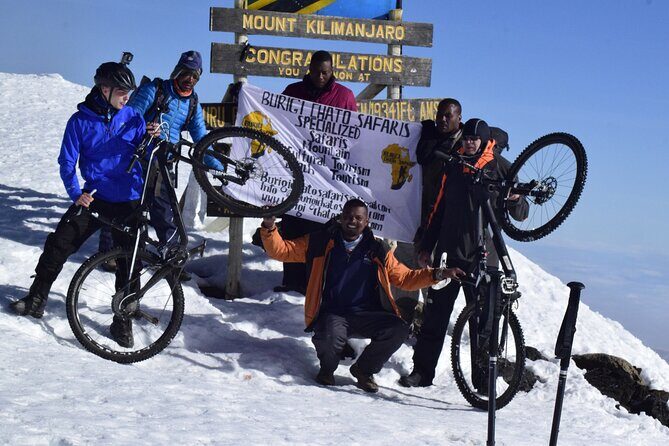
- Kilema route summit by bike with a summit-night schedule built around Uhuru Peak
- Moshi transfers and gate logistics handled so you don’t lose time at the park offices
- All meals and hut stays included, plus porter support for your duffel bags
- Real altitude riding through alpine desert and icecap terrain, not just scenery stops
- Early summit departure (around 4:00 am) and cold-weather prep for headlamps and batteries
Why riding Kilimanjaro up the Kilema Route feels different
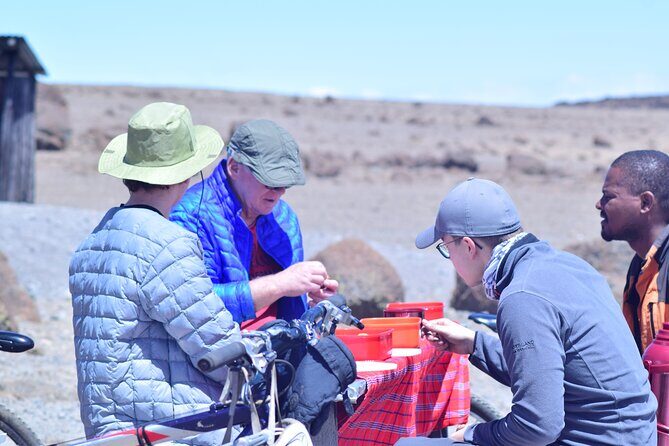
Most Kilimanjaro routes are built for walking, with bikes as a side note at best. This one is designed so you actually use a mountain bike as part of the climb, including the summit-night push and the rides that connect the major points. That shift changes the whole rhythm: you’ll spend more time moving and less time just hiking between rest breaks.
The Kilema route is also described as the only bike-accessible approach for this kind of mountain climb. For you, that matters because it keeps the day-to-day plan coherent—you’re not constantly switching between walking and biking, and you’re not guessing which segments are feasible on two wheels. It’s a niche experience, and it earns its niche status by matching the route to the activity.
You can also read our reviews of more cycling tours in Moshi
Moshi start, Marangu gate registration, and your packing reality
You’ll meet your guide in Moshi and then ride to the Marangu gate in about 45 minutes. At the park office, hikers need to register at the Marangu gate, and then the group drives onward to the Kilema gate. This means your day starts with a small admin step that you’ll want to treat like part of the adventure, not something to rush.
On arrival at the Kilema gate, you’ll do a practical pre-ride setup: check you have your daypack items and do a final check on your mountain bike. Your daypack needs basics like drinking water, your lunch pack, and extra clothing. You should take that seriously—altitude makes everything feel slower, and the cold can sneak up fast.
One more setup detail worth thinking about: the tour mentions duffel bags being packed and ready to go on the higher days. That’s the kind of system that keeps your riding day smoother because you’re not juggling your entire life in one backpack while the terrain gets technical.
Day 1: Kilema gate to Horombo Hut on a 16km first push
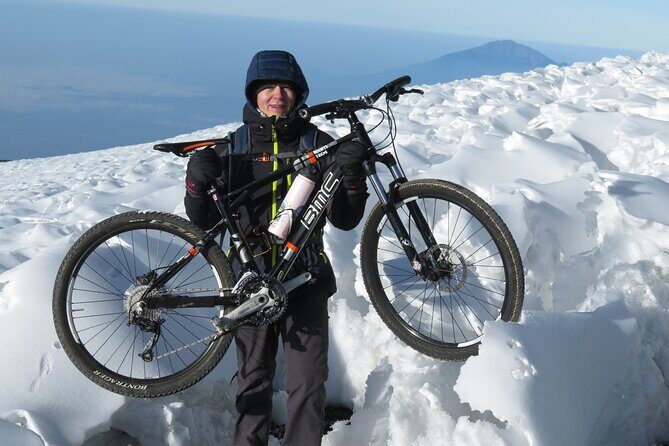
Day 1 starts at the Kilema gate at about 1,950m and rides you to Horombo hut at around 3,705m. The first cycling section is about 16km, and your guide rides alongside you on a mountain bike. This is a good “orientation” day: you learn the feel of the route and how the group moves in altitude without jumping straight into the hardest segments.
What I like about Day 1 is that it doesn’t pretend cycling is easy just because you’re using a bike. The elevation change is real, and you’re still building stamina from the start. If you’re the type who gets tense when you’re breathing hard, you’ll want to focus on controlled effort rather than speed, because the start sets the tone for the coming days.
Day 2: Alpine desert riding, mostly on the move
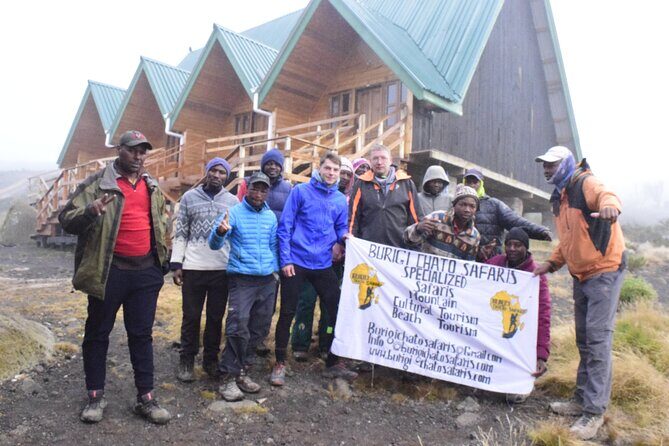
After breakfast, you start cycling through alpine desert vegetation. Today is described as about 10 kilometers of riding, and it’s framed as roughly 90% riding on that terrain. That’s a useful mental target: you’ll spend less time wondering what’s next and more time learning how to keep your legs from burning up at altitude.
Alpine desert riding isn’t just “pretty and quiet.” It often means thin air, cold air, and ground that can feel firm or gritty depending on conditions. The good news is that Day 2 gives you a bit more structure—shorter distance, less unpredictability—so you can settle into the pace and get used to the cold-weather rhythm.
Day 3: The rocky first 3km, the Saddle, then the hard slog toward Kibo
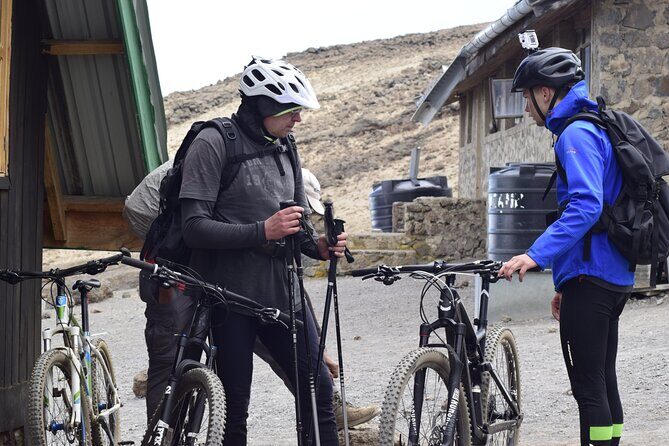
Day 3 is where the tour shows you exactly what Kilimanjaro bikes are really about. You begin with a rocky first 3km section where cycling gets very difficult because the trail is stony and eroded. After that, the route improves, and you’ll find cycling again becomes possible.
Then you reach the Saddle, the area between Mawenzi and Kibo, where the biking is described as relatively flat. It sounds like a break, but you’re still at high altitude, and the next big challenge is oxygen plus cold. The section of about 7km toward Kibo hut is described as strenuous for that reason, and the final kilometer before Kibo is especially hard—so you should plan to ride conservatively and drink enough water even when you feel like you’re just grinding.
This is also one of the days where your bike skills matter more than your fitness number. If your technique is shaky—braking late, wobbling on uneven ground, or sprinting when you should steady your breathing—Day 3 can feel longer than it reads on paper.
You can also read our reviews of more hiking tours in Moshi
Day 4: Rest, partial summit path orientation, then summit-night prep at Kibo
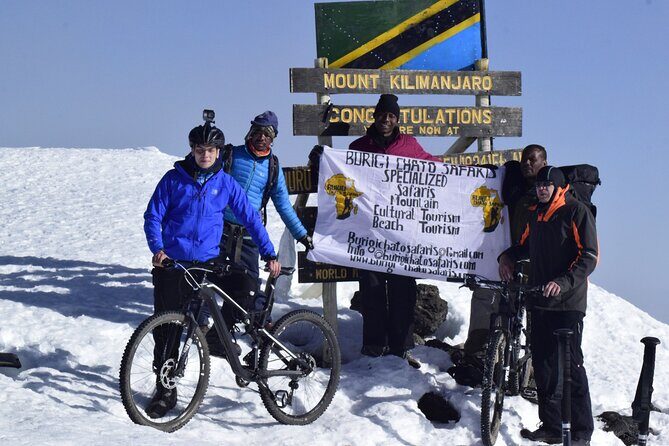
Day 4 begins with an early wake and packing your duffel bags. After breakfast, you head back up to Kibo hut, and the final 7km to Kibo is described as offering a good biking trail. That’s a nice setup because it lets you move on a more rideable section before the summit push.
You’ll have lunch at Kibo and aim to rest. Around 16h00, depending on how you feel, it’s possible to hike partially up the summit path to get your bearings for the attempt later that night. That small orientation can help you avoid that first-wrong-step feeling when the climb begins in the dark.
The tour then shifts into summit preparation, with Uhuru Peak about 1,195m higher. You’ll be advised to prepare thermal clothing and key gear, and the plan explicitly mentions replacing headlamp and camera batteries—and carrying spares. Cold can drain batteries faster than you expect, and the altitude can make you reluctant to stop, so it’s worth thinking through your power needs early rather than late.
One practical caution from mountain bike logic: water can be a problem when temperatures drop. Riders have shared that a water reservoir can freeze on summit night, which can leave you thirsty when you need fluids most. If you use a hydration system, treat it like a gear challenge, not a convenience.
Day 5: 4am start to Uhuru Peak—Hans Meyer’s Cave, Gilman’s Point, Stella Point
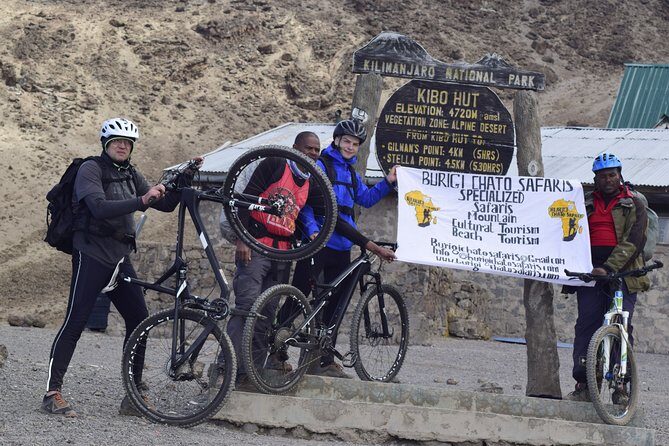
This is the day you came for. You’ll be awakened at around 4:00 am to start the zigzag climb on steep slopes. After roughly two hours, you should reach Hans Meyer’s Cave, where the gradient becomes steeper.
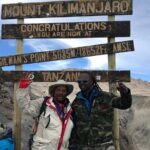
From there, the plan continues for about three more hours to Gilman’s Point. At that stage, porters handle the bike, and you take the bike back to ride to Uhuru Peak. You’ll reach Uhuru Peak, spend a few minutes there for photos, and then ride down toward Stella Point.
After lunch, you ride down to Horombo. The tour describes the terrain in terms of vegetation: cycling from Kibo to Uhuru involves alpine desert vegetation with about 15% to 20% vegetation, and the ride back down to Horombo is described as alpine desert vegetation and icecap terrain. In other words, you’re riding high and cold, not just “at elevation.”
This day also highlights why pacing is everything. Even when you’re on a bike, you can’t treat the summit like a race. The cold and low oxygen make every effort feel heavier, and the tour plan builds a schedule that assumes you’ll move steadily rather than aggressively.
Day 6: Final descent to Kilema Gate, then back to Moshi
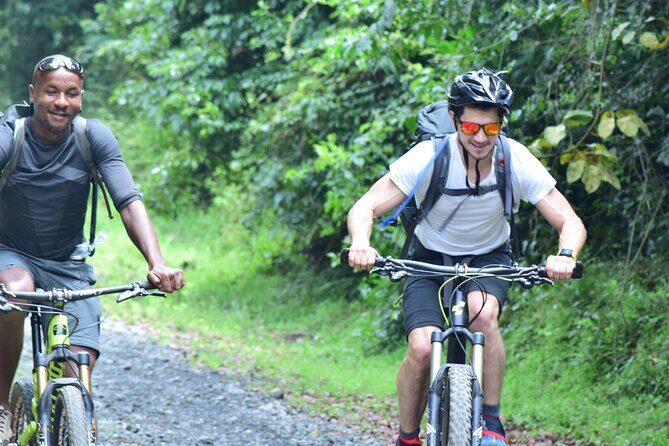
After breakfast at the hut, you make the final ride down to the Kilema gate. The route is described as crossing alpine and rainforest zones on the way down, and then you’re transferred to the Marangu gate for checkout. From there, it’s on to your hotel in Moshi.
What I like about the final day is that it closes the loop. You start at the gates, you climb through the zones, and you end by returning across terrain rather than simply teleporting down. The process also gives you a chance to settle your body after the big summit night—still riding, but less about pushing hard and more about controlled, safe movement.
Bikes, guides, and group size: what support really means here
This trip is built around a crew approach: guides are there on the bikes, and porters support luggage logistics. That matters because on Kilimanjaro, the hard part is usually not just the physical work—it’s the coordination of energy, timing, and gear when conditions shift.
The tour also notes a maximum group size of 200 travelers. That number is large on paper, but it doesn’t automatically mean you feel crowded. In mountain contexts, you’ll often experience the day as a moving unit of people rather than everyone packed on top of each other, especially once you’re out on the trail and moving at your own pace.
I also appreciate that this experience has a reputation for motivation and care. On Kilimanjaro, people can fall behind when altitude hits, and the tour’s structure includes support if you start feeling the effects of AMS. It’s reassuring to know the system isn’t just there for good weather and good vibes—it’s there for the moments when you need help.
The real value of $3,668 per person
At $3,668 per person, this isn’t a budget trip. But you’re paying for a lot that most lower-cost Kilimanjaro options separate out: private transportation, crew wages, gate transfers, and airport pickup/drop-off are included. You also get hotel accommodation before and after trekking, plus all meals during the trek.
You’re also getting park-related fees and taxes handled, and the tour includes accommodation in mountain huts during the climb. On top of that, porter support is included, and that directly impacts your comfort on riding days where you’d rather not carry everything yourself.
What’s not included is also clear: flights, tipping crew, visas, and mountain bike hiring are not included. Personal trekking mountain bike gear isn’t included either. So if you’re thinking about value, make sure you budget for your own kit and any bike-related items you’ll be responsible for, rather than assuming everything is handed to you.
A helpful way to judge value here: compare the all-in structure against piecing together separate rides, transfers, guide time, and entrance/park logistics. This tour charges a premium, but it also reduces the number of decisions you must make while you’re already adjusting to altitude.
Who this Kilimanjaro bike trek suits best
You should strongly consider this if you have moderate physical fitness and you genuinely want a mountain biking challenge at altitude. The tour is not presented as a casual ride, and the day-to-day reality backs that up with rocky sections early on Day 3 and strenuous, cold conditions on summit day.
You’ll also be happier if you can ride steadily over uneven terrain and you don’t panic when your breathing gets hard. The route makes use of bike segments, but it still expects you to handle difficult sections calmly and keep moving when it’s not easy.
If you’re mainly curious about Kilimanjaro and your bike skills are basic, you might find this harder than you expect. The good news is that the operator notes non-summit itineraries are available, which can be a more comfortable fit if your priority is the scenery and route experience rather than the summit goal.
Should you book the Marangu–Kilema bike trek?
Book it if you want Kilimanjaro in a way that’s built around riding, not just walking with a side of bikes. The combination of hut nights, gate-to-gate planning, all meals, and a summit-night schedule that includes a bike descent is what makes this feel like a true one-of-a-kind challenge.
Think twice if you’re sensitive to cold, easily stressed by technical trails, or you’re not comfortable riding on rocky, eroded ground at high altitude. You’ll also want to be honest with yourself about what you can handle in the early-morning summit climb, where you’ll be managing headlamps, batteries, and a body that’s already low on oxygen.
If you’re ready for that mix—altitude patience plus bike control—this is exactly the kind of trip you’ll remember as practical, not just dramatic.
FAQ
How long is the Kilimanjaro bike trek on the Marangu–Kilema route?
It’s listed as 6 days approximately.
What time does the tour start, and where does it end?
The start time is 9:00 am, and the tour ends back at the meeting point.
Is the tour a summit attempt to Uhuru Peak?
The experience summary describes summiting early in the morning, but non-summit itineraries are available as an option.
What’s the price, and is it per person?
The price is $3,668.00 per person.
What’s included in the price?
Included items cover private transportation, crew wages, gate transfer plus airport pickup and drop-off, all fees and taxes, hotel accommodation before and after trekking, and meals (breakfasts, lunches, and dinners). Porter support is also included.
What should I bring in my daypack?
You’re instructed to make sure your daypack has at least drinking water, your lunch pack, and extra clothing.
What’s not included?
Not included are flights, tipping the crew, visas, trekking mountain bike hiring, and personal trekking mountain gear.
Is the trek dependent on weather?
Yes. It requires good weather, and if it’s canceled due to poor weather you’ll be offered a different date or a full refund.